Sunday, March 25, 2012

Embroidering Hand Knitted and Crocheted Projects

When I make gifts for people I like to personalize them as much as possible.  One easy way to personalize a knit or crochet project is with embroidery. My two favorite embroidery techniques are Duplicate Stitch and using Waste Canvas.

Duplicate Stitch :
The simplest way to embroider Stockinette Stitch is with duplicate stitch.

I used duplicate stitch to embroider the word "Anvil" on this hat.  There are many videos on You Tube that demonstrate this technique quite nicely.  For duplicate stitch, you simply trace the existing stitches of the knitted material with a contrasting color so that the the embroidered stitches sit on top of the knitting and blend in with the stockinette fabric.  I used regular graph paper to plot out my letters, You have to keep in mind that the stitches are not exactly the same size and shape of the squares on your graph paper so your design will look a little different from what is on the paper.  

This is my messy worksheet, it isn't the prettiest of work, but it got the job done :P  

Notice the letters on the paper are a different size and shape than what is on the hat.  There is special graph paper you can get that is specifically for knitters, where the squares are more true to the shape of the stitches, but regular graph paper will work as long as your stitch count matches and you keep in mind the image will look a little distorted compared to what it looks like on paper.  The embroidery will look like part of the knitting for the most part,  except the embroidery stitches will be slightly raised, which is an effect that is very fitting for many projects.

Duplicate stitch is ideal for fitted garments, like hats, because the elasticity of the fabric is not noticeably compromised, the hat will keep it's stretchiness and still fit well.  I will often stretch the fabric as I go to ensure that the embroidered stitches are not to tight and stretch along with the fabric.  Another thing to keep in mind when doing this stitch is that you do not want to carry your yarn more than 1 or 2 stitches across the back of the work, as this will also affect the way the garment fits.  For the Anvil hat, the letters were 2 stitches apart and I used a separate strand of yarn for each letter.  Not carrying your yarn very far will mean more dreaded tails to weave in.  Most knitters, including myself, do not look forward to weaving in tails, but if it assures that the garment will fit well, then it is worth the extra work.

Embroidering with Waste Canvas :

Waste Canvas is one of those things that I wished I had discovered sooner, because I love to use it and use it often on both hand knitted and crocheted material.  When I first attempted to embroider something on my knitting and crochet using stitches other than duplicate stitch I was not happy with the results.  I found that my lines were not straight, sometimes the stitches would sink into the knitting and not be visible, and sometimes it was difficult to make the stitches even due to the stretchy nature of knitted fabrics.  I mentioned my frustrations to my sister-in-law, who is amazing when it comes to embroidery and Cross Stitch,  and she suggested I try Waste Canvas.  What wonderful advice!  

People who do Cross Stitch will often use Waste Canvas when stitching onto garments because it acts as a guide for their stitches.  I found that Waste Canvas was useful for embroidering on knitted and crocheted items for other reasons as well.  This special "temporary" canvas is made up of threads loosely woven together and then bound together with a mild glue.  The canvas provides a nice flat surface, making embroidery much easier, especially on stretchy Stockinette and Bumpy Crochet.  You simply attach the canvas with a basting stitch, embroider your design in any stitch you like, remove the basting stitches, and pull the threads of the canvas out with tweezers.  I found this method ideal for Knitting and Crochet because it does 2 very important things, it provides a flat smooth surface and it helps the embroidered stitches to stay on the surface, rather than sink in between the knitted stitches.  It also acts a spacer in that it creates just enough of a gap between the Knitting/Crochet and the embroidery so that the embroidery does not cause the knitting to buckle and bunch up; you get nice even stitches, not too tight and not too loose.  

These are some examples of embroidery that I have done on both crochet and knitting using Waste Canvas.  It works with both embroidery floss and yarn.  

Embroidery on crochet (on puppets that I made) using embroidery floss

Embroidery on knitting (a patch for a baby sized rocker jacket), with embroidery floss

Embroidered on Knitting with light weight yarn.

Also the baby rocker jacket.  The "Iron Maiden" is Floss, the "Led Zeppelin" is embroidered with white yarn.

Embroidery on the baby rocker jacket with Floss, made to look 'carved'.

Step by Step instructions for using Waste Canvas:

This is how I embroidered the Anvil on the Anvil hat.

1. Draw your design on paper.  Use a dark colored pen so you can easily see to trace the design onto the canvas.

2.  Cut a piece of canvas slightly larger than the image.  Be sure there is enough space between the edge of the canvas and the image so that you can attach it to your project with temporary basting stitches.

3.  Trace the design onto the center of the canvas.  If the design is really detailed, I will use a light table for this step, or I will only trace the main lines of the design and free hand the rest using the image as a guide.

4.  Pin the canvas in place.  I used an embroidery hoop, it is not necessary, but helpful to keep the rest of the garment out of the way.  If you use a hoop make sure you do not stretch the knitting tightly over it.  You want the fabric to be flat but not stretched, if it is tightly stretched your image may not land in the right place or the design will be bunched when you are done.

5.  With contrasting thread or yarn, sew the canvas in place with a temporary basting stitch, which will be removed later after embroidery is complete.

6.  Use thread or yarn to embroider your design.  I love to use whipped back stitch because it makes nice straight lines that sit neatly on top of the knitted surface, but any stitch will work with the canvas.

7.  After embroidery is finished, remove the basting stitches.

8.  With tweezers, begin removing the threads of the canvas.  This step can be a little tedious, especially in the beginning, but once you get going it will go quickly.  You can spray the canvas with water to loosen the threads, I don't usually wet it, but if you are having trouble getting started, wetting it may help.  I will begin by pulling all the threads around the edge of my design that are not sitting under the embroidery.  When you begin pulling the threads out from under the embroidery it may be helpful to hold the design flat so that the threads of the canvas sit straight, making it easier to pull out.

And that is it!  You now have a nice neat design that sits on top of your knitting, the canvas is gone!  
You can find Waste Canvas in the embroidery section of most Craft stores, including JoAnn's and Michaels.


Embroidery is a great way to add a personal touch to any project!    


Thursday, March 22, 2012

Knitted Animal Hats

Goodness, it has been a busy couple of weeks at our house!  We have recently adopted a lovable one and a half year old dog named Fritz and his cuteness as been quite distracting.

 Consequently, I have fallen way behind on my blogging.  I am still working on some tutorials for jazzing up and personalizing your knitted items, but in the meantime I thought I would share with you some animal hats I have been working on.


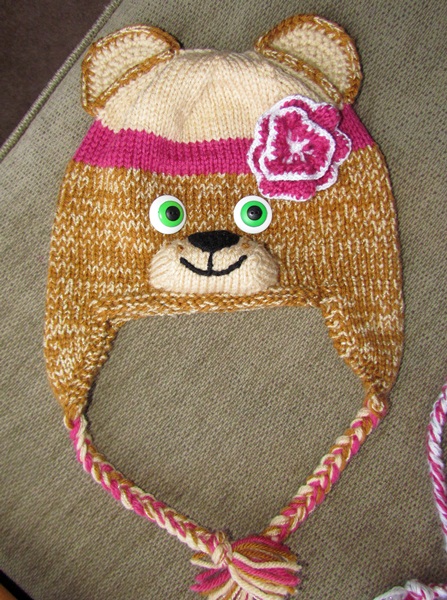
Inspiration for my designs often come from the children in my life and these hats are perfect example of that.  The Animal Hat Project began with the idea to make a monkey hat for a special little girl I know that recently celebrated her first birthday.  These animal hats are sock monkey inspired because the mother of the one year old that the monkey was made for told me a long time ago that she really liked the new-school sock monkey hats that she has seen lately, using  different colors besides the traditional sock monkey grey marl and red.

When my own children saw what I was making they asked if I could make them one too, but they wanted different animals.  This gave me the idea to use this as an opportunity to start working on a customizable animal hat pattern.  My plan is to write a pattern with many creative options.  The pattern will have six different animal options.  So far I have completed the first three animals.  Along with the monkey, rabbit, and bear,  I plan to have options in the pattern for an owl, tiger, and pig too.


This has been a really fun project to work on simply because I have let my creativity run wild.  I wanted these hats to be just as playful as the children who wear them, so I designed them to be bright and colorful.  The samples that I have completed so far have been made with little girls in mind, but my next sample will be the tiger and will show some boy options that will be included in the pattern.  
However, before I continue with writing this pattern I need to get focused and catch up on some of my homework for The CYC instructor program and TKGA master hand knitting program.   I only have a few swatches and assignments done, much less than I had hoped to get done by now.  As always, there is too much to do and never enough time to do it!


Monday, February 27, 2012

Free: Basic Adult Hat Knitting Pattern


I have been very busy making hats! Specifically, I have been making hats for my husband and his co-workers at  Anvil Tattoo. While making these hats, I thought it would be nice to share how I make a basic adult size knitted hat.


Basic Adult Knit Hat Pattern:

Yarn: Any worsted weight yarn. (the yarn in the sample photo is Vanna's Choice)

Needles: US size 8/5mm 16” circular and DPN

Gauge: 4” x 4” = 17sts. x 26 rows

Finished Measurements: hat height: 8 1/2”   circumference: 19”  (not stretched, laying flat)

CO 84 sts. Onto your circular needles, place marker, and join for working in the round.
R1-5: 1 x 1 ribbing, *K1, P1* repeat around
R6-41: Knit

begin decrease rounds:

R42: *K12, K2tog* repeat around =78sts
R43: Knit
R44: *K11, K2tog* repeat around =72sts
R45: Knit
R46: *K10, K2tog* repeat around =66sts
(note: if it is becoming tight to knit, now would be a good time to change to DPN)
R47: Knit
R48: *K9, K2tog* repeat around =60sts
R49: *K8, K2tog* repeat around =54sts
R50: *K7, K2tog* repeat around =48sts
R51: *K6, K2tog* repeat around =42sts
R52: *K5, K2tog* repeat around =36sts
R53: *K4, K2tog* repeat around =30sts
R54: *K3, K2tog* repeat around =24sts
R55: *K2, K2tog* repeat around =18sts
R56: *K1, K2tog* repeat around =12sts
R57: * K2tog* repeat around =6sts

Cut tail long enough to string the remaining 6 sts through with a yarn needle, tie off, and weave in ends.

Whenever I sit down to make an adult hat, I often start here, with this basic pattern. This simple pattern fits most adults comfortably and is easy to modify to suit my needs. To make a hat larger or smaller increase or decrease in multiples of 6. For stripes just change yarn color at the appropriate time. A folded brim can be made by adding more rows of ribbing. Making a more decorative brim is as easy as using seed stitch or different proportions of ribbing. When using finer yarns or smaller needles, simply knit a gauge swatch and adjust the pattern accordingly.
A long time ago I came across this excellent online resource for average head measurements according to age. Bev Qualheim and her friends were kind enough to compile size charts for head measurements as well other useful size charts.
 These charts can be found at http://www.bevscountrycottage.com. I love these charts because they are easy to follow, very straight forward. When designing your hat, keep in mind that the hat height measurements on this chart include a folded brim, if you don't want a folded brim be sure to make your hat height 1-3 inches shorter than the listed height.  Also, the hat circumference should be a few inches smaller than the head circumference listed, depending on how stretchy your hat is.

Another thing that I like to do, especially when knitting a gift, is to personalize the item in some way. I love to add details that are most meaningful to the person the gift was meant for. On my next blog post I am planning on sharing one technique I like to use when personalizing a knitted item.

As Always, knit long and prosper :)

Friday, February 24, 2012

A Knitting Method for my madness

I read my CYC knitting Teachers Handbook from cover to cover and I found it very thought provoking.  I know that sounds incredibly nerdy but it's true.

The 1st of many thoughts that came to mind:
When teaching a knitter to knit, you have to start with the basics and a good place to start would be the method.  How do you hold your yarn and needles?  Do you Pick or do you throw?  Do you control the working yarn with your left or right hand?  How do you tension the yarn to make your stitches even?

People have been practicing the craft of Knitting for centuries and as a result it has been elaborated on quite a bit and we humans, as crafty as we are, have come up with countless ways to go about it.  The most popular methods of modern knitters are Continental and English, or some variation of those.

 When I first learned to knit I would notice demonstrators using a seemingly unique knitting method and I would try it in hopes it might be faster or more comfortable.  Some methods I liked, some I didn't, and some I only liked under specific circumstances.  As a result, I am, for all intents and purposes, a Continental Knitter.   I control the working yarn with my left hand index finger and I pick rather than throw; however, I purl with my thumb, except when ribbing.  When I purl for ribbing I swing the yarn through to the front of my work with my index finger, swinging it over the needle, pressing the yarn down horizontal to the stitch, in one motion; simultaneously, I bring my thumb up to take over and complete the stitch. (I just had to go knit some ribbing and pay attention to what exactly I did in order to explain it.) I don't know the name of this technique, or if it is named, but I imagine most knitters, as they gain experience, will find their own way of manipulating their strings that is comfortable for them, just as I have done.

I am pretty comfortable with the way I knit, it is what works for me, but would it work for my students?  Maybe, maybe not.  So, I gave myself a little homework assignment, research knitting methods.   I think that this assignment will not only help me to become a better teacher, but also a better knitter.  Although I am comfortable with and have knitted in my usual fashion long enough that the motions have become automatic to me, I am still open to trying something new.  I like to be pleasantly surprised and perhaps I will discover a new method that might work even better for me in both speed and quality.

I decided to turn to my brand new copy of The Principles of Knitting by June Hiatt to begin my research.  I have to say I am impressed by the thoroughness of her book.  I especially love that she includes so many historical tid bits and trivia facts about knitting throughout her text.  In order to truly understand something, it helps to understand the origin from which it came.  My only criticism of the book so far is that sometimes her terminology is hard to follow because she does not always use the more commonly known terms in her text.  Instead of using the terms Continental and English, she uses "Left-Hand" and "Right-hand".  Although her terms are more literal, they are not the terms most commonly known.  At first glance I thought these listed methods might be alternative methods, then I read the description and realized what she was actually talking about.  I felt this was far to thorough of a book to exclude such well used terms, so I turned to the Index to find both Continental and English sited.  They were sited with "see Left hand method" and "see right-hand method".  I think that it would have been more clear had she just stated that in the actual text.

Despite this little pet peeve, I found the text rich with explanations of various knitting methods.  I read the entire chapter, which led me to search online for video demonstrations.  I am a visual learner and needed to see some of these methods in action in order to truly grasp them.

One method that really peeked my curiosity was the "Knitting Belt" method.  In the text the method is described as "fast and extremely efficient."  The dream of all knitters, the speed to squeeze in a few more projects (but when you are addicted enough is never enough).  The author also states, "Knit and Purl are done with nearly identical motions and facility, and there is no difficulty in working any stitch technique."  Wha-what???  easy and fast??  I had to see this for myself; there must be some kind of catch, otherwise it would be a more well known and popular method.  So I consulted the almighty internet and found this video on You Tube.  It is  a video of Hazel Tindall, the Worlds Fastest knitter, and sure enough, she uses a Knitting Belt.


In my research I found that one major reason why this method is not more popular is that the belts are extremely hard to find, unless, of course, you know how to work with leather and steel to make your own belt and specialized needles.  In fact, I only found one place, located in the UK, that sells them, Jamieson & Smith Shetland Wool Brokers Ltd. .  The belts were probably even more inaccessible before the internet came to be.  Why is this method not more widespread?  June Hiatt offers and interesting explanation, Victorian middle class women might have thought it less refined and wanted to distance themselves from the crafts working class origins.  Possibly, the industrial revolution and the invention of machine knitting might have also contributed to making these belts obsolete, making speedy hand knitting less necessary.  

Never the less, I really would like to try this someday.  I have bookmarked the webpage and added it to my knitting wish list.  


Tuesday, February 21, 2012

My new knitting books!!!

I recently got a much anticipated package in the mail!  New Books!  Up until now I relied solely on my local library for knitting reference books, but I decided it was about time I had some of my very own.  I love new books, especially knitting books!  I just love the shiny newness; the crisp, glossy, untarnished pages; the way the spine makes a cracking sound when you first open them; the new book smell.  Have I told you, I love getting new books!  The only thing that compares to getting a new book is getting new office supplies, but I will save that topic for a later blog.   The only thing I like more than getting new books, getting new yarn and needles!  After receiving them, I spent a few hours admiring them in all of their glory.


I got Vogue Knitting: The Ultimate Knitting Book , The Knitting Answer Book , The Principles of Knitting , and Finishing School: A Master Class for Knitters .

 I have only had a short time with my new books, but I can tell you The Principles of Knitting is like the bible for knitters.  It has well over 600 pages of solid information, just about everything you would ever want to know about knitting in one convenient location.  The author of this book, June Hiatt, is well known in the world of knitting and was kind enough to compile much of her knowledge into one convenient book.  Her book has been around for a long time and has recently been revised and updated, and now I am the proud owner of her revised edition!  Yayyy!!  

Vogue Knitting has great, easy to follow illustrations, which is helpful if you are a visual learner like me.  I think that the detailed body measurement charts and Knitting Worksheet will prove very handy for designing.  Browsing this book has inspired me to get a little more organized.  I now have reason to revisit my giant folder of tiny scrap papers and notebook full of chicken scratch and attempt to make sense of it all.

Finishing School is a book I have been looking forward to getting because that is an area I really want to improve.  I really want to learn how to make my knits look more professional and good finishing techniques can make all the difference in the world. The first section I turned to when I opened this book was the section on blocking.  I have read and heard so many conflicting opinions about blocking.  When you should or should not block?  Which method is best?     Many knitters swear by blocking and will block anything and everything they knit.   Secretly, I had held the opinion that not everything needed blocking.  I had kept that opinion to myself for a long time, not wanting to hear the gasps of dismay from other knitters, but so far this book has helped to reassure me that my opinion might  not be as blasphemous as  I thought.  On the very first page of the chapter on blocking Deborah Newton states, "I believe less is more when it comes to blocking."  Now that I know there is an expert in the field that shares my opinion on this I am no longer ashamed to say, "I don't block everything!"  Now that my dirty little secret is out, I want to shout it from tree tops!  

I ordered the Knitting Answer Book for one simple reason, when I am in a knitting bind I want a quick solution to my problem.  We have all been there, up all night trying to finish something and then you realize you have made a terrible mistake and do not have the time to undo hours of work and start over.  I really hope that this book will have the answers I need to get me out of trouble in a hurry.  

I love my new books!  I have a few more I want to get, but I think these will keep me occupied for a while. And the best part is, they are all mine!!  I don't have to return them to the library; I can do whatever I want with them.  I can highlight, write in the margins, fill them with bookmarks that I never have to take out, and I don't have to panic if I spill a little of my morning coffee on them (not that I would ever let that happen!)